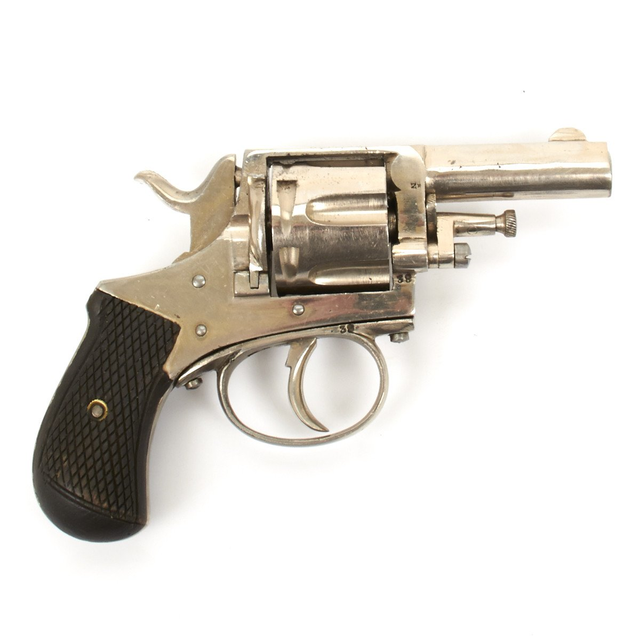
Original Model 1868 Webley .38 British Bull Dog Revolver
International Military AntiqueInternational Military Antique
3.0

Original Model 1868 Webley .38 British Bull Dog Revolver

USD 595.00

Description

Original Item: Stout and strong, these little revolvers are built like their namesake canine. With connections to a presidential assassination, an eccentric general and the Wild West, British Bulldogs may be the most collectible uncollected guns on the market. British Bulldogs are cute but mean, bark with bite. I recently came across a pair of unmatched, but nonetheless beautiful Belgian-made Bulldogs, which made me wonder why I knew relatively nothing about them. The well-kept secrets of these dogs are finally off the leash, as the previously un-collected British Bulldogs are beginning an upward trend on the firearms market. This particular example has Belgian proof marks so was it was produced there in the 1880s. It is fully nickel plated, has a cylinder capacity of six .380 caliber cartridges. It is in operating condition but the trigger return spring is either absent or very weak. Lineage The pocket revolver known primarily as the "British Bull Dog" was first produced by P. Webley & Sons of Birmingham, England, in 1872. Its appeal was so great that the "British" Bulldog was adopted and copied by gun manufacturers in Belgium, Spain, France and the U.S. Though American-made Bulldogs came from the armorers Iver Johnson, Harrington & Richardson, Forehand & Wadsworth, and several other makers who quickly went in and out of business, the Webley versions are rightly considered the real McCoy. Though the revolver remained in production until the WWI-era, the hay day of the Bulldog was in the 1870s to 1880s, a time when it was known its affordability and reliability, consequently making it one of the most popular pocket pistols in both Europe and America. Though Colt is the brand we all know and love, and their single actions are thought to have fit the hip of near every cowboy, ranch-hand and gunslinger, Colt's single-actions sold for three to four times the cost of the British Bulldogs. The inexpensive, yet solidly made little dogs - many of which survive as shooters today - were available to everyman. Build Though this little gun has had as many variations and names as it had makers, the general features are quite simple: a 2.5-inch barrel, five-round capacity, double-action trigger, and an overall true small-frame pocket pistol. Bulldogs are quickly recognizable by the bird's head grips, generally made of either walnut or pearl. However, there are many fine examples with sweet ivory grips and delicate engraving. Most had a blued finish, but some nickeled models have survived as well. The revolver is generally dressed with simple fixed sights, a large looping trigger guard, curvaceous hammer spur and weigh in around 20 ounces. Many European Bulldogs were chambered for .44 Short, .442 Webley, .455 Webley and .450 Adams, but there are several smaller variations of Webleys chambered in .320 and .380 calibers, though they were produced much later and were never labeled as Bulldogs. Both the American and Belgian Bulldogs, which seem to be the most prevalent on the market these days, were readily available in smaller calibers. Perhaps the most common American clones housed .44 Webley and .38 caliber chamberings. Famous ties The Bulldog revolver has connections both famous and infamous in American history, as detailed George Layman's book "The British Bulldog Revolver: The Forgotten Gun that Really Won the West!" Probably the most infamous connection places it in the hands of Charles Guiteau, the man who shot President James Garfield in 1881. Though the wounded President lived for several months under the rudimentary medical care of the time, he succumbed to the pair of bullet wounds almost three-months later. As the story goes, Guiteau was reportedly furious that Garfield overlooked him for appointment to a federal post and vowed to take vengeance on the President - and to do so with a good-looking gun, but one that could be had on a budget. Guiteau is said to have used a Belgian-made British Bulldog in .44 caliber, but interestingly there is some debate over whether Guiteau got his wish of acquiring one with ivory grips. As rumor has it, he wanted his gun to look good when it eventually made its way to a museum, but the ivory upgrade cost several dollars more than the walnut model, which sold in the $8 to $12 range. The gun commonly shown as Guiteau's model in period illustrations has walnut grips, but the actual gun is, in fact, long gone. Following Guiteau's trial, the revolver was on loan to the Smithsonian, but, a short time later, the revolver disappeared and has not been found to this day. It is unclear whether the gun disappeared during its stay with the museum or sometime later.

Get a discount on Original Model 1868 Webley .38 British Bull Dog Revolver

You could save on International Military Antique Original Model 1868 Webley .38 British Bull Dog Revolver with a International Military Antique promo code:
    International Military Antique logo

    5% off

    23 uses
    high

    worked about 1 month ago

    5% Off Storewide at International Military Antique
View all International Military Antique coupons and promo codes

More International Military Antique Products

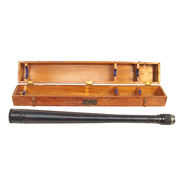
Original U.S. WWII Navy 16x MkII Quartermaster Spyglass Refracting Telescope by Hayward Lumber with Wood Case - Dated 1942

Original U.S. WWII Navy 16x MkII Quartermaster Spyglass Refracting Telescope by Hayward Lumber with Wood Case - Dated 1942

Original Item: Only One Available. A refracting telescope (also called a refractor) is a type of optical telescope that uses a lens as its objective to form an image (also referred to a dioptric telescope). The refracting telescope design was originally used in spyglasses and astronomical telescopes but is also used for long-focus camera lenses. Although large refracting telescopes were very popular in the second half of the 19th century, for most research purposes, the refracting telescope has been superseded by the reflecting telescope, which allows larger apertures. A refractor's magnification is calculated by dividing the focal length of the objective lens by that of the eyepiece. Refracting telescopes typically have a lens at the front, then a long tube, then an eyepiece or instrumentation at the rear, where the telescope view comes to focus. Originally, telescopes had an objective of one element, but a century later, two and even three element lenses were made. Refracting telescope is a technology that has often been applied to other optical devices, such as binoculars and zoom lenses/telephoto lens/long-focus lens. This is a wonderful example of a 1942 Spyglass, used by Quartermasters aboard US Naval ships during WWII. Quartermasters (QM) stand watch as assistants to Officers of the deck and navigators. They serve as helmsman and perform ship control, navigation and bridge watch duties. Your duties may include: Procure, correct, use and stow navigational and oceanographic publications and oceanographic charts. A telescope would have been an important piece of equipment for them to use! These are the MkI Spyglass and have a serial number of 25840. The optic lenses are still very clear and still able to be focused properly. There are markings present on both the telescope and the case. Markings on Case U.S. NAVY SPYGLASS QUARTERMASTER MARK II 16 POWER BU. SHIPS SERIAL 14720, 1942 CONT. NO. NXS-8533 CHEMICAL & MFG DIVISION HAYWARD LUMBER & INV. CO. LOS ANGELES Markings on Telescope U.S. NAVY SPYGLASS QUARTERMASTER MARK II 16-POWER BU SHIP SERIAL 1942 HAYWARD LOS ANGELES Both of these items are in lovely, barely used condition and still very functionable today. Comes ready to display in your US Navy collections! Approximate Box Dimensions: 32 œ” x 4 œ” x 4 Ÿ”

USD 295.00

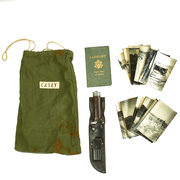
Original U.S. Vietnam War Named 5th Special Forces Group Fighting Knife with Photos and 1967 Passport

Original U.S. Vietnam War Named 5th Special Forces Group Fighting Knife with Photos and 1967 Passport

Original Items: One-f-a-kind set. Fantastic Vietnam MACV SOG Special Forces Bowie knife has a black/red coated clip point blade with hidden tang and double guard. Knife features a stacked leather contoured grip with aluminum pommel and aluminum guard. Blade is marked on the ricasso with special forces insignia and marked on the blade 5TH SPECIAL FORCES GROUP (Abn) VIETNAM, blade measures 6 in, overall 10 5/8 in. Comes complete with black leather sheath with a sharpening stone pocket. Also included is a ditty bag with name tag that reads CASEY. Inside the bag is a 1967 dated United States of America passport named to Dennis Ray Casey, there are also 34 original black and white photos which clearly show Casey in uniform in the field during the Vietnam war. An incredible Vietnam War Special Forces Grouping! Fearing the growing threat of the Viet Cong insurgency to the South Vietnamese government, President John F. Kennedy began activating special forces units in anticipation of their insurgency combat expertise in 1961. The 5th Special Forces Group was among those units activated in 1961, and while attending training at the Special Warfare Center, Kennedy visited the units and personally approved the distinctive Special Force's Green Beret. The 5th SFG was first deployed as a battlefield advisory group for the Army of the Republic of Vietnam (ARVN). In 1964, the 5th Special Forces Group contracted with Vietnamese and other Southeast Asian producers to make fatigues and other items such as boonie hats using Tigerstripe fabric. By February 1965, it was deployed as a mainstay battle force once the war was in full swing. They used unconventional and conventional warfare and were some of the last soldiers the United States pulled out of Vietnam. The group's personnel in Vietnam adopted a variant flash with an added diagonal yellow stripe with three narrow red over-stripes to the existing black background with white border from 1964 to 1970. These colors symbolize the 1st and 7th SFG Soldiers who served under 5th SFG during the Vietnam War.[8] The reason was that the group had a black flash bordered in white was to provide visibility against the beret from 1970 to 1985 it was adopted by the entire Group.[9] It reverted to the plain black flash on 16 January 1985. On 23 March 2016, the 5th Special Forces Group changed over to the Vietnam-era flash to pay respect to the unit's history and the Green Berets of the past who are part of the unit's history. The 5th Special Forces Group (Airborne) was unique in the Vietnam War for its heavy usage of watercraft, particularly Hurricane Aircat airboats. The 5th Special Forces Group launched a wide-ranging campaign against Viet Cong forces in the Mekong Delta in July 1967. The campaign conducted jointly with the South Vietnamese Army, civilian irregulars, and the US Navy and Air Force, was built around the use of some 400 watercraft, including 84 airboats, as well as helicopters, US Navy warships, and civilian vessels. The extensive naval operations required an overhaul in tactics to allow the 5th Special Forces Group to employ the speed and firepower of the Airccat airboats to their maximum effect. When used in concert with armed helicopters, Patrol Air Cushion Vehicle hovercraft, and support from Air Force reconnaissance planes, Navy river patrol boats, and artillery, these watercraft enabled "telling victories over the Viet Cong" and turned the flood season into a significant tactical advantage for the United States. The use of watercraft, increases in troop strength, and introduction of other tactics—deploying more soldiers to Civilian Irregular Defense Group (CIDG) bases, distributing improved handbooks to commissioned and non-commissioned officers, etc.— allowed the 5th Special Warfare Group to take the fight to the enemy, capturing large swaths of territory in the Delta, making the 50 percent of the territory and CIDG bases that were previously too overrun with Viet Cong to enter safe enough to operate in, and mounting operations and establishing CIDG bases deep in Viet Cong territory. These gains were not without cost, however: 55 Special Forces and 1,654 Vietnamese were killed during 1967, as well as an estimated 7,000 Viet Cong. In June 1969 the killing of a suspected double agent Thai Khac Chuyen, and the attempt to cover it up, led to the arrest in July of seven officers and one non-commissioned officer of the 5th Special Forces Group (Airborne) including the new commander, Colonel Robert B. Rheault in what became known as the "Green Beret Affair".[14] Chuyen was working with the 5th on Project GAMMA when the Green Berets learned he might be a double agent. He underwent about ten days of rigorous interrogation and solitary confinement before he was shot and dumped into the sea. National newspapers and television picked up the story, which became another lightning rod for anti-war feeling. Finally in September 1969 Secretary of the Army Stanley Resor announced that all charges would be dropped since the CIA, which may have had some involvement, refused to make its personnel available as witnesses. In April 1970, 5th SFG began reducing its number of personnel in Vietnam. Later in November and December, further reductions in personnel and extraction of companies ensued, ending in a complete withdrawal of the group by March. On 5 March 1971, 5th SFG returned to Fort Bragg. The 6th SFG at Fort Bragg was reflagged as the 5th SFG with the transfer of colors. Personnel and equipment were not transferred. Sixteen Soldiers assigned to or administratively assigned to 5th Special Forces Group (Airborne) during the Vietnam War were awarded the Medal of Honor; making 5th Group the most prominently decorated unit for its size in that conflict. Members of the unit continued to conduct intelligence operations in Southeast Asia until the collapse of the South Vietnamese government on 29 April 1975. The Military Assistance Command, Vietnam – Studies and Observations Group (MACV-SOG) was a joint unconventional warfare task force created by the Joint Chiefs of Staff as a subsidiary command of the Military Assistance Command, Vietnam (MACV). The unit would eventually consist primarily of personnel from the United States Army Special Forces. Others assigned to MACV-SOG came from the United States Navy SEALs, the United States Air Force, the Central Intelligence Agency (CIA) Special Activities Division, and elements of the United States Marine Corps Force Reconnaissance units. The Studies and Observations Group was in fact controlled and missioned by the Special Assistant for Counterinsurgency and Special Activities (SACSA) and his staff at the Pentagon. After 1967 the HQ 5th Special Forces Group (Airborne), provided administrative support to MACV-SOG Special Forces soldiers in Vietnam.

USD 2195.00

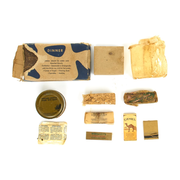
Original U.S. WWII K-Ration Dinner Unit - Unissued

Original U.S. WWII K-Ration Dinner Unit - Unissued

Original Items: Only One Available.The K-ration was an individual daily combat food ration which was introduced by the United States Army during World War II. It was originally intended as an individually packaged daily ration for issue to airborne troops, tank crews, motorcycle couriers, and other mobile forces for a short duration. The K-ration provided three separately boxed meal units: breakfast, dinner (lunch) and supper (dinner). The K-ration originally came packed in an unbleached tan-colored rectangular cardstock box with black lettering. The outer box was printed on its top in bold capital sans serif block letter type with the text: "US ARMY FIELD RATION K", with the meal unit type (BREAKFAST, DINNER, or SUPPER UNIT) printed underneath it and a capital letter on each end (B, D, or S). While it was intended that the three meals be eaten in their named order, they were not always consumed in this manner. The inner box had the meal unit type printed across its top and a capital letter on each end (B, D, or S). The later "Morale Series" had unique packaging designs that were color-coded and letter-coded on the ends for quick identification. The breakfast ration box had brown printing and was marked with a brown capital letter "B" on the ends, the dinner ration box had blue printing and was marked with a blue capital letter "D" on the ends, and the supper ration box had olive drab printing and was marked with an olive drab capital "S" on the ends. The packaging commencing with the earliest version of the ration consisted of a chemically-treated cardboard outer carton and a waterproofed waxed-cardboard inner carton to protect the contents from contamination or damage. The waxed carton was found useful by soldiers to start small fires in which to boil water for coffee or cocoa. The entrĂ©e came in a small, round metal can painted green with black lettering, with a metal key (dubbed a "twist key") to open it, packaged in a roughly square 3 × 23⁄4 × 17⁄16 inch (7.5 × 7 × 3.7 cm) cardboard box. The rest of the meal came packed neatly in a waxed paper or laminated cellophane pack. The pack always contained two packages of 8 rectangular K-1 or 4 square K-2 calorie-dense cracker biscuits each, a 4-pack of commercial-grade cigarettes, and either a flat rectangular stick of chewing gum or a square piece of candy-coated gum. Special items (like matches or Halazone tablets) were packed in one unit but not the others due to space limitations. Late production meals added a paper-wrapped paddle-like disposable wooden spoon and used the standard P-38 can opener instead of the "twist key". This K-ration set contains the following items: - Processed American Cheese and Bacon entrĂ©e contained in a small, round metal can painted green with black lettering. - 8 rectangular K-1 cracker biscuits - 4 Pack of Camel cigarettes - Matchbook - 1 stick of Wrigley's Cinnamon Chewing Gum - Cubed Sugar - Mars candy bar. - Powdered beverage packet orange (c. 1943) Idiot Clause - the contents of this kit are pre-1945 manufacture and are NOT suitable for consuption. They are being sold as novelty collector pieces only. Even though some people on youtube have tried. Yuk!

USD 350.00

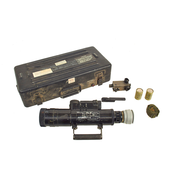
Original U.S. Army Vietnam Era AN/PVS-2 Starlight Night Vision Scope with Transit Chest

Original U.S. Army Vietnam Era AN/PVS-2 Starlight Night Vision Scope with Transit Chest

Original Item: Only One Available. The U.S. Army AN/PVS-2 is a first generation night vision device, first developed during the Vietnam war era, which quickly went through several different revisions. While very large and heavy by "modern" standards, the 6 pound passive starlight PVS 2s were considered state of the art when it came to the capabilities of U.S. troops fighting at night. These scopes first entered service at the height of the Vietnam War, and despite their cumbersome size and weight, they did prove its use among Soldiers and Marines in their patrol bases. It was probably too heavy to carry out on many patrols, but as a rifle equipped with one on a post at night where mobility wasn’t an issue, it could be a force multiplier, especially when the Viet Cong wanted to strike or probe the lines at night. These early design night vision devices were passive, and did not emit any light of their own, relying on incoming light. This was then amplified using a photocathode and an image intensifier tube in order to significantly increase image contrast. As they emit no light of any kind (IR/UV/etc) they are not detectable, however this also means that they are of limited use when there is no ambient light, which is why they are usually termed "starlight" scopes. Clear nights with star or moon light are optimal, while a cloudy night with no moon far from a city renders them ineffective. The AN/PVS-2 was intended as a rifle scope, and has a standard mount on the bottom for attaching to rails, such as used on the M-16 rifle. A switch on the upper left activates the scope, which can be used during the day with the attached daylight filter. The rubber eyeshield has an internal "flapper" closure that prevents light from escaping the back of the scope, helpful during clandestine operations. There is a focus control near the eyepiece, and there are instructions on the left side of the scope. This scope was in service for years, and the data label on the right side of the scope gives information regarding the version: U.S. ARMY NIGHT VISION SIGHT SUBASSY. MX-7833/PVS2 F.S.N. 5855-832-9223 SERIAL NO. 22978 We have not been able to test the optic, so they are being sold purely as a novelty/display. The set does come with 3 batteries (one inside the device) but they are from the 1980s/90s and no longer function. BOTH rifle mount accessories are included, the mount for the scope and the mount for the M14 rifle. The original transit chest measures approximately 21" x 10" x 5", and is in very good condition with all present latches working (one is missing), and the internal foam padding in

USD 795.00

You May Also Like