
International Military Antique Promo Codes and Coupons December 2025

International Military Antique logo

International Military Antique

IMA-USA is a Japanese-American fashion retailer specializing in contemporary women's clothing, accessories, and lifestyle products. They blend modern Japanese aesthetics with American casual wear, offering minimalist designs and quality materials. The brand operates both online and through select physical stores across major US cities.

ima-usa.com

Today's International Military Antique discount codes

TOP PICK
International Military Antique logo

5% off

23 uses
high

worked about 1 month ago

5% Off Storewide at International Military Antique
International Military Antique logo

5% off

13 uses
high

worked about 1 month ago

5% Off Storewide at International Military Antique
International Military Antique logo

5% off

18 uses
high

worked about 1 month ago

5% Off Storewide at International Military Antique
International Military Antique logo

5% off

20 uses
high

worked about 1 month ago

5% Off Storewide at International Military Antique

Featured International Military Antique Products

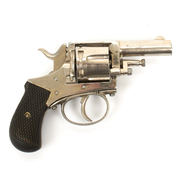
Original Model 1868 Webley .38 British Bull Dog Revolver

Original Model 1868 Webley .38 British Bull Dog Revolver

Original Item: Stout and strong, these little revolvers are built like their namesake canine. With connections to a presidential assassination, an eccentric general and the Wild West, British Bulldogs may be the most collectible uncollected guns on the market. British Bulldogs are cute but mean, bark with bite. I recently came across a pair of unmatched, but nonetheless beautiful Belgian-made Bulldogs, which made me wonder why I knew relatively nothing about them. The well-kept secrets of these dogs are finally off the leash, as the previously un-collected British Bulldogs are beginning an upward trend on the firearms market. This particular example has Belgian proof marks so was it was produced there in the 1880s. It is fully nickel plated, has a cylinder capacity of six .380 caliber cartridges. It is in operating condition but the trigger return spring is either absent or very weak. Lineage The pocket revolver known primarily as the "British Bull Dog" was first produced by P. Webley & Sons of Birmingham, England, in 1872. Its appeal was so great that the "British" Bulldog was adopted and copied by gun manufacturers in Belgium, Spain, France and the U.S. Though American-made Bulldogs came from the armorers Iver Johnson, Harrington & Richardson, Forehand & Wadsworth, and several other makers who quickly went in and out of business, the Webley versions are rightly considered the real McCoy. Though the revolver remained in production until the WWI-era, the hay day of the Bulldog was in the 1870s to 1880s, a time when it was known its affordability and reliability, consequently making it one of the most popular pocket pistols in both Europe and America. Though Colt is the brand we all know and love, and their single actions are thought to have fit the hip of near every cowboy, ranch-hand and gunslinger, Colt's single-actions sold for three to four times the cost of the British Bulldogs. The inexpensive, yet solidly made little dogs - many of which survive as shooters today - were available to everyman. Build Though this little gun has had as many variations and names as it had makers, the general features are quite simple: a 2.5-inch barrel, five-round capacity, double-action trigger, and an overall true small-frame pocket pistol. Bulldogs are quickly recognizable by the bird's head grips, generally made of either walnut or pearl. However, there are many fine examples with sweet ivory grips and delicate engraving. Most had a blued finish, but some nickeled models have survived as well. The revolver is generally dressed with simple fixed sights, a large looping trigger guard, curvaceous hammer spur and weigh in around 20 ounces. Many European Bulldogs were chambered for .44 Short, .442 Webley, .455 Webley and .450 Adams, but there are several smaller variations of Webleys chambered in .320 and .380 calibers, though they were produced much later and were never labeled as Bulldogs. Both the American and Belgian Bulldogs, which seem to be the most prevalent on the market these days, were readily available in smaller calibers. Perhaps the most common American clones housed .44 Webley and .38 caliber chamberings. Famous ties The Bulldog revolver has connections both famous and infamous in American history, as detailed George Layman's book "The British Bulldog Revolver: The Forgotten Gun that Really Won the West!" Probably the most infamous connection places it in the hands of Charles Guiteau, the man who shot President James Garfield in 1881. Though the wounded President lived for several months under the rudimentary medical care of the time, he succumbed to the pair of bullet wounds almost three-months later. As the story goes, Guiteau was reportedly furious that Garfield overlooked him for appointment to a federal post and vowed to take vengeance on the President - and to do so with a good-looking gun, but one that could be had on a budget. Guiteau is said to have used a Belgian-made British Bulldog in .44 caliber, but interestingly there is some debate over whether Guiteau got his wish of acquiring one with ivory grips. As rumor has it, he wanted his gun to look good when it eventually made its way to a museum, but the ivory upgrade cost several dollars more than the walnut model, which sold in the $8 to $12 range. The gun commonly shown as Guiteau's model in period illustrations has walnut grips, but the actual gun is, in fact, long gone. Following Guiteau's trial, the revolver was on loan to the Smithsonian, but, a short time later, the revolver disappeared and has not been found to this day. It is unclear whether the gun disappeared during its stay with the museum or sometime later.

USD 595.00

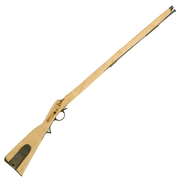
Brunswick P-1837 Percussion Two Groove Rifle Replacement Hardwood Wood Stock

Brunswick P-1837 Percussion Two Groove Rifle Replacement Hardwood Wood Stock

New Made Item: High quality reproduction British Brunswick P-1837 Percussion Two Groove Rifle Replacement Hardwood Wood Stock. The stock is fully inleted and comes complete with brass trigger guard, brass butt plate, brass patch box cover and clasp, brass left side lock screw escutcheon, brass nose cap, blued steel ram rod and trigger assembly. The inlets are cut to approximate size so custom fitting of your specific parts will be required. Wood is sanded but untreated for you to stain and finish. Approximate overall length is 46".The Brunswick rifle was a large calibre (.704) muzzle-loading percussion rifle manufactured for the British Army at the Royal Small Arms Factory at Enfield in the early 19th century. The Brunswick rifle was one of several designs submitted to replace the Baker rifle. Unlike the Baker rifle, the Brunswick rifle used a special round ball with raised ribs that fit into two spiraling grooves in the barrel.During its evaluation, it was noted that the Brunswick's unique round meant that the Brunswick rifle could not fire the standard British paper cartridges in use at the time. The rifle was also noted as being very heavy, and that it fired a relatively low velocity round. Despite these detriments, the rifle performed much better than expected, and the Master-General of Ordnance ordered the rifle to be produced with a 30-inch barrel of .654 caliber. The new rifle was designed to accept a bayonet, though the design was changed with the mounting moved farther back since experience had shown that the Baker rifle could not be fired with its bayonet fixed.In December 1836, trials were conducted to compare the Brunswick rifle against the Baker rifle. The Brunswick rifle proved to be equally accurate at shorter ranges, and more accurate at longer ranges. The Brunswick rifle also proved to require less cleaning than the Baker rifle. Evaluators also noted that the simplified two groove design of the Brunswick was likely to have a longer service life than the barrel of the Baker, and the Brunswick rifle was noted as being very rugged overall. In January 1837, the rifle was approved for production.Almost immediately, the caliber was changed from .654 to .704 under a new program of standardization. An altered pattern was submitted in August 1837, and the first bulk order of 1000 rifles was given on October 25, 1837. In January of the following year, it became apparent that 600 of these would be required urgently for Col. Brown’s Battalion of the Rifle Brigade and that the Enfield factory would not be able to supply them in time. Thus the whole order was put out to the trade in London at a charge of 38s per rifle. 1838, and the first mass-produced rifles were issued to the Rifle Brigade, the Canadian Rifle Regiment, and a few specialized units in 1840.The Brunswick rifle developed a reputation for being difficult to load, but was fairly well received and remained in production for almost 50 years. The rifle was used in England and assorted colonies and outposts throughout the world. Several refinements were made to the design during its production life, and production of the rifle was finally discontinued in 1885.The Brunswick was also manufactured in Belgium. Limited numbers of Brunswick rifles were imported to the United States during the Civil War. Some of those ended up in the hands of units like the 26th Louisiana Infantry, which was partly equipped with Brunswicks during the Siege of Vicksburg.The rifle takes its name from the German state of Brunswick.The Pattern 1836 featured the original back action lock and the single compartment patch box. The first of these were .654 caliber. This was changed fairly early in the rifle's life, and most were .704 caliber. All subsequent patterns were .704 caliber.The Pattern 1840 featured a dual compartment patch box, and had several minor improvements to the Pattern 1836.The Pattern 1841 replaced the back action lock with a side lock. However, this lock change was not put into manufacturing until 1845. This version also used a wrought iron barrel instead of twisted steel, and a simple plug that replaced the break-off breech plug used in earlier patterns.The Pattern 1848 featured other minor improvements, and used an improved bayonet latch with the locking notch located halfway along the bayonet bar on its upper side. Only a few batches of rifles produced for the British Army were fitted with this improvement.A heavier version in .796 caliber was produced for the Royal Navy.Copies of the Brunswick rifle were made in Nepal, from approximately 1840 to 1860. These copies were apparently hand made, and as such their details varied slightly. There were two distinct versions, a "light" pattern that weighed approximately 7.5 lbs, and a version that was more similar to the standard Brunswick rifle that weighed over 9 lbs. It is estimated that approximately 10,000 to 12,000 of these were made in Nepal.

USD 325.00

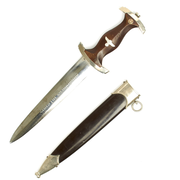
Original German WWII SA Dagger RZM M7/42 by WKC - Excellent Condition

Original German WWII SA Dagger RZM M7/42 by WKC - Excellent Condition

Original Item: Only One Available: This Weyersberg, Kirschbaum & Co SA Dagger is a wonderful clean example. The crossguards are nickel and in great condition. The surfaces are smooth with good crisp edges and precise accent grooves. The tang nut matches nicely and does not appear to have been out in modern times. The grip is a fine fruit wood, medium brown in color and with a subtle vertical grain. The SA symbol button is perfectly placed and the enamel is in good shape. The nickel grip eagle is clean and crisp. The bird retains full detail through the breast and wing feathering, talons and wreathed immobile swas. The grip fits the guards like a glove and is in perfect condition. The scabbard is straight throughout. It has a nearly perfect deep brown paint. The scabbard mounts are in excellent condition and all of the screws are in place. The blade of this dagger is fantastic, bright and having much of the original grain. There are some in and out marks but it still rates in excellent condition. The motto is deep and crisp, with a fine frosted background typical of WKC. The ricasso has the RZM circle and M7/42 maker marking. The blade shoulders perfectly meet the crossguard contour. M7/42 stands for the firm Weyersberg, Kirschbaum & Co and has been manufacturing military swords and cutlery in Solingen, Germany- a city famous since the middle ages for its metal-working and craftsmanship in sword making. The traditional manufacturing of swords at WKC dates back to the year 1774 when the Weyersberg first registered the ''Kings head'' as their trademark. Later in 1883 the company merged with the Kirschbaums and the company WKC was formed as it exists today. An excellent SA Dagger from one of the most famous makers who used top quality materials. History of the SA- The SA or Brown Shirts, were a private political formation which Adolf AH and the NSDAP used to maintain order at organized Party meetings and demonstrations. The group was formed in 1921, and grew to a huge force of nearly 3,000,000 men by the later 1930's. To instill esprit de corps, as well as create employment for the Blade City of Solingen, it was decided each SA man would carry a dagger with his Brown Shirt uniform. Huge quantities needed to be produced to accommodate the demand. The dagger initially was produced of hand-fitted nickel mounts with attractive finished wood grip and brown anodized (a bluing process) finished scabbard. The blade was etched with the SA motto, Alles für Deutschland. Examples produced prior to 1935 were stamped with the German sector of the SA group on reverse lower crossguard. Later examples underwent standardization through the RZM ministry. These pieces were produced of cheaper plated zinc-base fittings and scabbards were simply painted brown. Prior to his "unmasking" as a traitor, Ernst Röhm was the leader of the SA. In 1934, he distributed approximately 100,000 SA daggers with his personal inscription on the reverse blade. These daggers were to honor individuals who had served with the SA prior to December, 1931. Other than the inscription, these pieces were identical to the standard M1933 SA dagger. After the Röhm purge, the inscription was ordered to be removed. Many examples were returned to the factory for grinding. Others were simply ground in the field by whatever means were available. Examples will occasionally be encountered with remnants of the original inscription remaining on the blade, but mostly none will remain. Some blades exist with an intact inscription, reflecting only the removal of the Röhm signature. Very very rarely is an example seen with a full, untouched inscription, as the holder would have surely risked a charge of treason.

USD 895.00

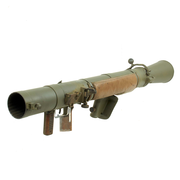
Original Cold War Era Carl Gustaf M2 84mm Deactivated Recoilless Rifle Anti-Tank Launcher - Inert

Original Cold War Era Carl Gustaf M2 84mm Deactivated Recoilless Rifle Anti-Tank Launcher - Inert

Original Item: Only one available. This example is totally inert and incapable of firing having been deactivated in accordance with guidelines provided by the BATF. A hole has been cut on the rear left the same diameter as the bore, as shown in the pictures, which is now covered by the left side pad. The firing pin has been removed and the firing pin retainer drilled out with a 1/2" bit through the other side, and a 1/2" steel bar welded across the bore in its place. All other mechanisms have been rendered inert. NOT AVAILABLE FOR EXPORT. NOT AVAILABLE TO CALIFORNIA RESIDENTS. In terms of recent military weapons that make impressive wall-hanger display pieces, Anti-Tank launchers definitely take the cake. They may not be as impressive as the tank itself, but they are also far more display friendly, and require far less maintenance, preparation, and so forth. This is a great cold war era Swedish Carl Gustaf M2 84mm shoulder fired recoilless rifle, originally developed in the late 1940s as a crew-served man-portable infantry support gun. The design and various types of ammunition used made it suitable for close-range multi-role anti-armor, anti-personnel, battlefield illumination, smoke screening and marking fire. The design also has seen great export success around the globe and continues to be a popular multi-purpose support weapon in use by many nations. At just 44 1/2 inches long Carl Gustaf 84 mm recoilless rifle is a lightweight, low-cost weapon that uses a wide range of ammunition, which makes it extremely flexible and suitable for a wide variety of roles. Unlike many similar weapon systems that are single use, this could be used repeatedly by the squad in a variety of uses. There were several versions of the Carl Gustaf 84mm Recoilless Rifle released, and this is the M2 "Export", introduced in 1964 as an improved, lighter and slightly shorter version of the original M1 for the export market. It quickly replaced the original version, and was the version that really popularized the system during the Cold War Era. There are some markings in Hebrew near the rear blast nozzle, so we believe this example saw use in Israel. As it is "recoilless", that does mean that anyone standing to the rear of it is in quite a bit of danger due to the back blast, as well as the pressure wave from firing. In general members of the squad were limited to a set number of firings per day due to the stress on the body, and this is probably why in Australia, it is irreverently known as "Charlie Gutsache" (guts ache, meaning stomach pain). Even those several meters to the side could still suffer the effects. This is the first time that we have had one of these, and it looks to be in great shape, having been repainted following deactivation. The fold out front and rear sights on the left side are still present, as are both hand grips and the shoulder rest. The trigger is present but does not really move, nor does the safety. The rear nozzle can be rotated into the loading position, however the latch definitely takes a rubber mallet to move. These were often issued with a monopod, but this example no longer has it. A great example of a very hard to find recoilless rifle, ready to display! More on the Carl Gustaf Recoilless Rifle:Development of the initial model started from 1946 as one of the many recoilless rifle designs of that era, based on the experience from the earlier Carl Gustaf 20 mm recoilless rifle and the success of man-portable rocket launchers during World War II, such as the bazooka and Panzerschreck. Production of the initial model was handled by Carl Gustafs Stads Gevärsfaktori led by Försvarets Fabriksverk (FFV) and the weapon received the designation 8,4 cm granatgevär m/48, (8,4 cm grg m/48 – "8,4 cm grenade rifle", model 1948) in Swedish service. FFV would continue to further develop the weapon for the international market, later being merged into Saab Bofors Dynamics which handles development and export today. While similar weapons have generally disappeared from service, the Carl Gustaf is still in production and remains in widespread use today.

USD 4495.00

What International Military Antique coupons are available today?

We track so many discount codes. Read about today's International Military Antique coupon statistics.

34
International Military Antique deals available today
11
Active International Military Antique codes
5% off
Biggest discount available
Get the best International Military Antique promo codes and coupons that actually work. Our community of sustainability minded shoppers helps you save by testing and sharing:
  • Verified promo codes with live success rates from recent shoppers!
  • Exclusive single-use codes shared by our community (34 active codes).
  • Drop alerts when International Military Antique's most popular items go on sale!
  • Deals for those who want extra savings opportunities
  • Insider savings tips from experienced International Military Antique shoppers who know the best deals.

Why TerraCoupons finds better International Military Antique discounts:

  • Live success tracking: See exactly which codes are working for other shoppers right now
  • Real-time feedback: Every code attempt is tracked and ranked to show you the best options first
  • Sale predictions: Get alerted when International Military Antique's next big discount event is coming
  • Exclusive savings: reseller discounts, shopping tips and sustainability tips you won't find elsewhere
Note: Our community tests every International Military Antique promo code and shares results in real-time. Check success rates and shopping tips in the activity feed to find what works best for your purchase.
International Military Antique logo

5% off

22 uses
high

worked about 1 month ago

5% Off Storewide at International Military Antique
International Military Antique logo

5% off

25 uses
high

worked about 1 month ago

5% Off Storewide at International Military Antique
International Military Antique logo

5% off

15 uses
high

worked about 1 month ago

5% Off Storewide at International Military Antique
International Military Antique logo

5% off

24 uses
high

worked about 1 month ago

5% Off Storewide at International Military Antique

More International Military Antique Products

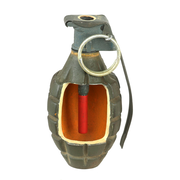
Original U.S. WWII Inert MkII Pineapple Grenade with Yellow Ring & M10A2 Fuze Cutaway Visual Training Aid from Aberdeen Proving Grounds

Original U.S. WWII Inert MkII Pineapple Grenade with Yellow Ring & M10A2 Fuze Cutaway Visual Training Aid from Aberdeen Proving Grounds

Original Item: Only One Available. Totally inert and demilitarized according to BATF guidelines with hollow body and inert fuse. This grenade cannot be converted to an explosive device and is not available for export. When it comes to designing a training program for military personnel, instructors are faced with several challenges. First, unlike athletes there is no off-season, most units are either preparing for deployment, deployed, or refitting from deployment. Secondly, training facilities vary from location to location and often focus on a single task. These tasks may include muscular strength, cardiovascular endurance, field craft or marksmanship. Each of the above contribute to the success of an operation, however there is one area of training that is deficient. This deficiency is visual training; visual ability plays a larger role in achieving optimum performance than most military personnel realize. The goal of integrating visual training into an already packed curriculum is not to dilute it but to improve tactical performance. To help users better understand the equipment they are using, examples like this cutaway were made. These were intended to give the users a look at the internal structure of the explosives, showing the different layers as well as where they connect or thread into each other. This is an iconic U.S. fragmentation pineapple grenade issued during WWII. The Mk II was standardized in 1920 replacing the Mk I of 1917. It was phased out gradually, the U.S. Navy being the last users, on 2 April 1945 the Mk II and Mk IIA1 were re-designated the Mk 2 and Mk 2A1. The Mk II was commonly known as a pineapple grenade, because of its shape and structure. Grooves were cast into the cast iron shell, which was believed at the time to aid in fragmentation and had the side benefit of aiding in gripping the grenade; this provision gave it the appearance of a pineapple fruit. The Mk II was identified with an all yellow body prior to 1943. They were then painted olive drab for camouflage purposes with a narrow yellow band below the fuse. In the closing years of WWII the Mark II was produced with a solid base and equipped with the M10A3, or M6 series fuze (depending on the explosive filler used). This example is in lovely condition with almost all of the original paint still present, as well as a visible yellow band still around the neck. The top of the fuze is not marked as being an M10A2 due to a hole being cut into the top so you can see the inside fuse placement. We were told that this cutaway came from Aberdeen Proving Grounds, but we have no provenance to back this up. This iconic grenade comes ready to be added to your collection! The Mk 2 grenade (initially known as the Mk II) is a fragmentation type anti-personnel hand grenade introduced by the U.S. armed forces in 1918. It was the standard issue anti-personnel grenade used during World War II, and also saw limited service in later conflicts, including the Korean War and Vietnam War. Replacing the failed Mk 1 grenade of 1917, it was standardized in 1920 as the Mk II, and redesignated the Mk 2 on April 2, 1945. The Mk 2 was gradually phased out of service as the M26-series (M26/M61/M57) grenade was introduced during the Korean War. Due to the tremendous quantity manufactured during World War II the Mk 2 was still in limited issue with the US Army and US Marine Corps throughout the 1950s and 1960s. The U.S. Navy was one of the last users of the Mk 2 when it was finally withdrawn from U.S. military service in 1969, replaced with the M33 series (M33/M67). The Mk 2 grenade did not widely replace the failed Mk 1 grenade used by the U.S. military during World War I. Although 44 million were ordered and more than 21 million were completed (it was possible to convert Mk 1 grenade bodies to the Mk 2 configuration) before the war ended, few reached American troops overseas. It was formally standardized in 1920. The Mk 2, like the Mk 1, was manufactured of cast iron with a grooved surface divided into 40 knobs in 5 rows of 8 columns. This was intended to enhance fragmentation (in practice, it was found that the grooves did not enhance fragmentation as much as desired) and provide a better grip when handling and throwing the grenade. The grooves and knobs gave it the appearance of a pineapple, and are the origin of the nickname. It was also commonly referred to as a "frag" grenade, in contrast to other types of grenades such as the Mk 3 concussion grenade also developed during World War I. The Mk 2 used the M5, M6, M10, M11, or M204 series fuses. The early M5, and the later M6 and M204 series detonating fuses, were used on high explosive-filled grenades. The M10 and M11 series igniting fuses were used on low explosive-filled ones. The early fuses had many problems. In the M5, moisture could get in under the foil fuse cap, causing the weapon to fail to detonate. The early fuses were not completely silent and made a loud "bang" and produced sparks when activated. They also made a faint "hissing" sound while burning, potentially alerting the enemy of their presence. The M10, used during the interwar period, and the M10A1, used early in WWII, sometimes prematurely detonated when the flash from the primer hit the explosive charge rather than the delay fuse. They were replaced by the M10A2 and M10A3. A less common type of igniting fuse was the M11. The M6A4C had a delay of 4 seconds. The M5 and M11, like the M10, M10A1 and M10A2, had a delay of 4 to 5 seconds. The later M10A3 had a delay of 4.5 to 5.3 seconds. In 1944, the M6A4C was replaced by the silent and more reliable 4 to 5 second delay M204 or M204A1 fuse. Due to the large number of grenades already issued, few grenades with the new fuses were used in combat during WWII.

USD 495.00

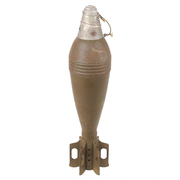
Original U.S. WWII Inert M43A1 81mm Mortar Round with M52 PD Type Fuze

Original U.S. WWII Inert M43A1 81mm Mortar Round with M52 PD Type Fuze

Original Item: Only One Available. Totally inert and demilitarized according to BATF guidelines with hollow body and inert fuse. This mortar round cannot be converted to an explosive device and is not available for export. This is a totally genuine United States military WWII produced SHELL, M43A1, with an inert fuze. The fuse base unscrews to allow the explosive chamber to be inspected. The fuse is missing the button on top but the rest of the fuse which is marked RH along with WCM stamped in ink. The round measures roughly 13⅞” long. The fins are marked B-S. Perfect for any WWII ordnance display! The SHELL, H.E., M43 was originally adapted as the light shell for the 81-mm mortar. It is designed for use against light targets such as machine gun nests, barbed wire entanglements and personnel in the open. Shell body. The body of this shell is constructed of forged steel. It is tear-dropped in shape; that is, blunt nose and tapered tail. It has a bourrelet machined near the nose of the shell consisting of several annular grooves which serves to act as a forward bearing surface and a gas check. The action of the propelling charge gasses expanding in the grooves and contracting to pass the raised portions tends to slow the gasses and prevent their passing the bourrelet. The nose is machined and threaded to receive an adapter. The adapter is threaded and acts as a bushing for bakelite fuse well cup and the fuse. The bakelite fuse well cup is fitted to the adapter before it is assembled to the shell body and prevents the entrance of foreign material into the fuse cavity prior to the assembly of the fuse to the round. The fuse used is the Point-detonating Fuse M45. This fuse has a selective element and can be set for either super quick or delay action. To the rear of the bourrelet is a curved taper reducing the base of the shell to approximately 1 1/Z inches. The base is closed and machined so as to receive a stabilizer assembly. The shell filler is 1.22 pounds of TNT. The total weight of the completely assembled round is 7.05 pounds. Entire length of the fused shell is 13 1/4 inches. The fin assembly consists of a machined cartridge container to which six stationary fins are attached. One end is closed and threaded so as to be screwed on to the body of the shell. The other end is machined and hollow inside so as to receive the ignition cartridge. Several holes leading from the interior to the exterior periphery of the cartridge container serve to conduct the flames from the ignition cartridge to the propellant increments which are seated in the fins.

USD 495.00

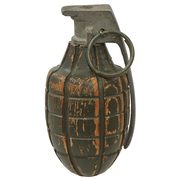
Original U.S. WWII Inert Wood & Aluminum MkII Pineapple Grenade “Shop Copy” Visual Training Aid from Aberdeen Proving Grounds

Original U.S. WWII Inert Wood & Aluminum MkII Pineapple Grenade “Shop Copy” Visual Training Aid from Aberdeen Proving Grounds

Original Item: Only One Available. Totally inert and demilitarized according to BATF guidelines with hollow body and inert fuse. This grenade cannot be converted to an explosive device and is not available for export. When it comes to designing a training program for military personnel, instructors are faced with several challenges. First, unlike athletes there is no off-season, most units are either preparing for deployment, deployed, or refitting from deployment. Secondly, training facilities vary from location to location and often focus on a single task. These tasks may include muscular strength, cardiovascular endurance, field craft or marksmanship. Each of the above contribute to the success of an operation, however there is one area of training that is deficient. This deficiency is visual training; visual ability plays a larger role in achieving optimum performance than most military personnel realize. The goal of integrating visual training into an already packed curriculum is not to dilute it but to improve tactical performance. This is a great “Shop Copy” wood & aluminum fabrication of a Mk. II hand grenade, as used for testing/trials/familiarization at the Aberdeen Proving Ground in Maryland. This is certainly a period manufacturer, with OD green paint that has heavily chipped away over the years. The fuze is held on with a single flat-head screw in the center, and has a pull ring. It is a slight bit larger than an actual Mk. II, and the construction at the bottom of the grenade shows its intricacies. A great wartime shop copy used for training, ready for further research and display!

USD 295.00

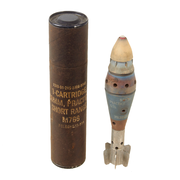
Original U.S. Gulf War / GWoT Era Inert M766 Short Range Practice 60mm Mortar Round With M779 Practice Fuze in Original Husk

Original U.S. Gulf War / GWoT Era Inert M766 Short Range Practice 60mm Mortar Round With M779 Practice Fuze in Original Husk

Original Item: Only One Available. This was intended for practice and training and was not filled with any explosive content. The propulsion charges are inert and or not present, making this round BATF compliant. This cannot be converted back to a “live” destructive device and is Not Available For Export. The M766 Short Range Practice Cartridge is designed for use with the M224 60mm Mortar System and provides realistic, cost effective training. The M766 is similar to the 60mm High Explosive cartridge in exterior configuration and operation. With the use of a refurbishment kit the M766 can be fired between ten and two dozen times. It reduces the cost of training and permits training in areas with limited range space. The M766 is equipped with the FUZE PD PRACTICE M779 which is a facsimile M734 Multi-Option Fuze. The cartridge, which has a maximum range of 538 meters, provides a flash, bang and smoke signature upon an impact and whether or not they need to adjust. This example comes complete in its original husk which is marked to the side: 1310-01-216-2706-8645 1-CARTRIDGE, 60MM, PRACTICE, SHORT RANGE, M766 POL99HQ33-014 The innovative refurbishment kit, consisting of a breech plug, ignition cartridge, fuze, obturator ring, three dud plugs and three increment plugs, saves 60mm mortar crews over $5M in training per year. The removable increment plugs, located on the shell body, simulate the propelling charges of the tactical cartridges and allow the crew to adjust the range. The dud plugs, also located on the shell body, are a safety feature indicating proper functioning of the fuze. The M766 consists of the following major components: Projectile Body Assembly M986 Ignition Cartridge M33 Fin Assembly M779 Practice Fuze This is a wonderful example and comes ready for further research and display!

USD 295.00

International Military Antique logo

5% off

35 uses
high

worked about 1 month ago

5% Off Storewide at International Military Antique
International Military Antique logo

5% off

100 uses
high

worked about 1 month ago

5% Off Storewide at International Military Antique
International Military Antique logo

5% off

85 uses
high

worked 10 months ago

5% Off Storewide at International Military Antique
International Military Antique logo

10% off

4 uses
low

worked about 1 year ago

10% Off Storewide Other at International Military Antique

Sustainability Score

62%
While IMA-USA has made progress with sustainable materials and packaging initiatives, they lack transparency in their supply chain and manufacturing processes. Their labor practices documentation is limited, and their animal welfare policies need improvement. They have started implementing renewable energy in some facilities but haven't set comprehensive environmental targets. The company shows potential but needs stronger commitment to sustainability goals and better reporting practices.

About International Military Antique

3.0 (2)

FAQs

Our largest sales occur during end-of-season clearances (January and July), Black Friday, and our Anniversary Sale in April.

Yes, we offer a 10% discount to students with valid ID, applicable both online and in-store.

For best prices, shop end-of-season sales: winter items in January/February, summer items in August/September. Sign up for our newsletter to get early access to sales.

We offer price matching on identical items from authorized retailers within 14 days of purchase.

In the past month, International Military Antique has launched 0 new promo coupons for shopper discounts. This indicates that International Military Antique does not provide regular opportunities for customers to save money on their purchases.

On average, International Military Antique provides 5 discount coupons each month. Based on historical data, the average time between International Military Antique coupon releases every 6 days. However, this rate depends on various factors such as seasonal promotions (Black Friday, Cyber Monday, etc.), product launches, or other marketing initiatives. To stay informed about upcoming discounts and promotions, we recommend checking International Military Antique website regularly, subscribing to email newsletters, and following them on social media.

International Military Antique is offering 11 working store-wide codes, however they are also offering 23 additional discount codes with a best discount of 5% off

terra.coupons is the #1 provider of discount codes for your favorite retailers, such as International Military Antique. As a crowd-sourced platform for coupon codes, we accurate codes for over 10,000 stores. Save time and avoid expired codes by checking terra.coupons for the latest International Military Antique discount codes.

Curated by

Linda S.

Linda S.

Content Writer

Last updated December 2025

This page was curated by Linda, a savings and discount enthusiast from sunny Sarasota, Florida. With a keen eye for unbeatable deals, Linda ensures that all codes are checked and curated daily. She's also a certified yoga instructor who loves to share wellness tips. Check back tomorrow for more savings and perhaps a little zen!

Latest International Military Antique coupon activity

Track real-time International Military Antique coupon activity from our community. See which codes are working right now at International Military Antique, when they were last verified, and any usage restrictions. Our feed helps you quickly find active codes and avoid expired ones.

From the blog

How to Negotiate Lower Bills on Subscriptions and Monthly Services

Effective strategies to reduce your subscription and monthly service bills through negotiation, smart planning, and leveraging available tools.

Unlock Huge Savings: Get the Best Soundboks Discount Today!

Unlock Huge Savings: Get the Best Soundboks Discount Today! Discover eco-friendly ways to save big on Soundboks speakers, find refurbished deals, and shop smartly!

The Best Time to Buy Electronics, Clothes, and More: A Year-Round Savings Calendar

Learn the best months to buy electronics, clothes, home goods, and more for maximum savings.